Fit Testing
What Is Respirator Fit Testing? A Plain-English OSHA Guide
 Kevin Rittger, MD, FACEP, Founder and Medical DirectorUpdated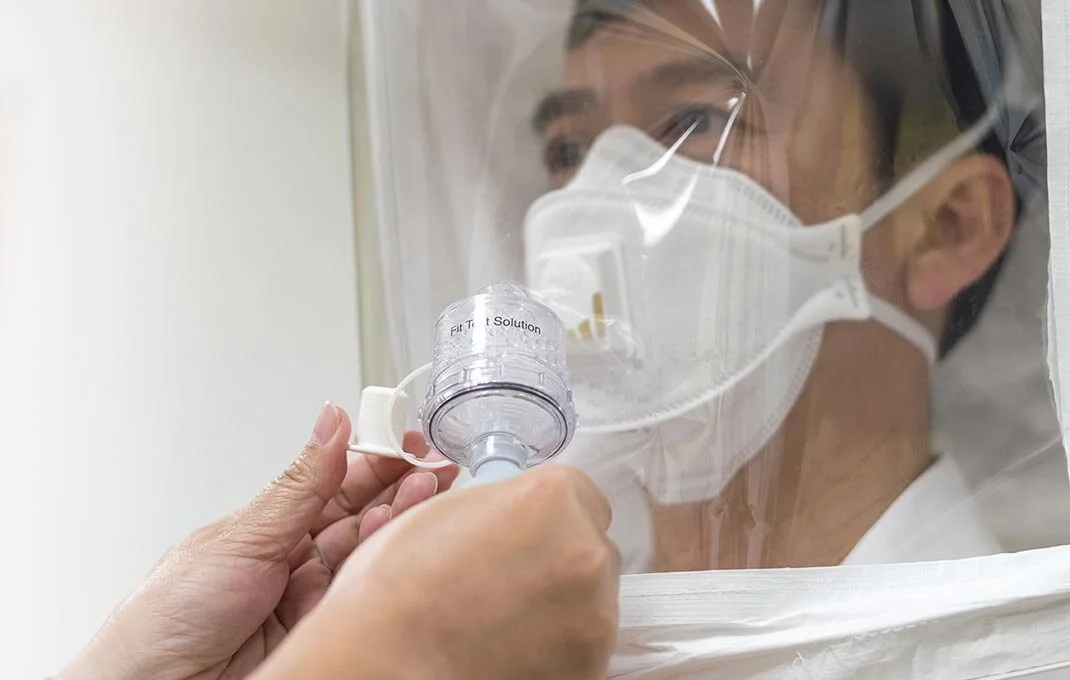
Key Requirement: Employers must fit-test every employee who wears a tight-fitting respirator before initial use, whenever a different respirator facepiece is used, and at least annually thereafter. — 29 CFR 1910.134(f)(2)
What Is Respirator Fit Testing?
Fit testing is a procedure that verifies a specific respirator forms an adequate seal on a specific worker's face. No two faces are identical — bone structure, skin texture, facial hair, weight changes, and dental work all affect how a respirator seals. A fit test confirms the selected make, model, and size actually protects that individual worker.
Important distinction: Fit testing is not the same as a user seal check. Workers perform seal checks (positive/negative pressure tests) every time they don their respirator. Fit testing is a formal, documented procedure conducted by a trained administrator using standardized protocols.
Why Does Fit Testing Matter?
A respirator that doesn't seal properly provides little or no protection — regardless of its assigned protection factor (APF). Studies show that without fit testing:
- Up to 50% of workers may select respirators that don't fit properly
- Actual workplace protection can be 10–100× less than the rated APF
- Workers have a false sense of security while being exposed to hazardous atmospheres
OSHA requires fit testing because it is the only reliable way to verify that a respirator will perform as designed for a specific individual.
Who Needs a Fit Test?
Any worker required to wear a tight-fitting respirator must be fit tested. This includes:
- Half-face air-purifying respirators (APRs)
- Full-face air-purifying respirators
- Tight-fitting powered air-purifying respirators (PAPRs)
- Half-face or full-face supplied-air respirators (SARs)
- Self-contained breathing apparatus (SCBA)
Who does NOT need a fit test:
- Workers using loose-fitting PAPRs or hoods
- Workers using loose-fitting supplied-air hoods or helmets
- Workers who voluntarily wear filtering facepiece respirators (dust masks) when not required by the employer (though OSHA strongly recommends it)
When Is Fit Testing Required?
OSHA mandates fit testing at these intervals:
| Trigger | Requirement |
|---|---|
| Before initial use | Before a worker may use a tight-fitting respirator in the workplace |
| Annually | At least every 12 months from the previous fit test |
| Respirator change | Whenever a different respirator facepiece (size, style, model, or make) is used |
| Physical changes | When changes occur that could affect respirator fit (significant weight change, facial scarring, dental changes, cosmetic surgery) |
| Worker reports issues | When the employee reports that the fit is unacceptable or the respirator doesn't seal properly |
Qualitative vs. Quantitative Fit Testing
OSHA recognizes two categories of fit testing, each with specific approved protocols.
| Feature | Qualitative (QLFT) | Quantitative (QNFT) |
|---|---|---|
| How it works | Uses test agent (taste/smell) to detect leakage — pass/fail | Uses instrument to measure actual leakage — numerical result |
| Approved protocols | Isoamyl acetate (banana oil), saccharin, Bitrex, irritant smoke | Ambient aerosol (CNC/CPC), controlled negative pressure (CNP), generated aerosol |
| Result type | Pass or fail (subjective) | Fit factor number (objective) |
| Limitation | Can only be used for half-face respirators (APF ≤ 10) | Can be used for any tight-fitting respirator |
| Equipment cost | Low ($50–$200 for test kits) | High ($5,000–$15,000+ for instruments) |
| Time per test | ~15–20 minutes | ~5–10 minutes (after setup) |
| Pass criterion | Worker cannot detect test agent | Fit factor ≥ 100 (half-face) or ≥ 500 (full-face) |
| Best for | Small programs, low budget, half-face respirators only | Large programs, full-face respirators, higher confidence |
Qualitative Fit Test (QLFT)
The worker dons the respirator and is exposed to a test agent inside an enclosure (hood). If the worker can taste or smell the agent, the respirator fails. The worker performs exercises (normal breathing, deep breathing, head side-to-side, head up-and-down, talking, grimace, bending over, normal breathing again) during the test.
Quantitative Fit Test (QNFT)
A probe is inserted through the respirator facepiece and connected to an instrument that measures particle concentration inside vs. outside the respirator. The resulting ratio is the fit factor. The worker performs the same exercises during testing.
How Can Employers Conduct Fit Testing?
Employers have several options for conducting fit testing:
Option 1: Hire a Vendor or Mobile Fit Testing Service
- Third-party industrial hygiene or safety companies come on-site
- They provide all equipment, trained personnel, and documentation
- Best for: companies without in-house safety staff or infrequent testing needs
- Typical cost: $50–$150 per employee per test
Option 2: Use a Clinic or Occupational Health Provider
- Send workers to a clinic that offers fit testing services
- Often combined with medical clearance evaluation
- Best for: small companies with few respirator users
- Typical cost: $75–$200 per employee (may include medical clearance)
Option 3: Conduct Fit Testing In-House
- Train an employee to become a fit test administrator
- Purchase fit testing equipment (QLFT kits or QNFT instruments)
- Maintain documentation and records internally
- Best for: companies with many respirator users or frequent new hires
- Requires initial investment in training and equipment but lowest per-test cost long-term
Who Can Perform a Fit Test?
OSHA does not require fit test administrators to hold a specific certification or license. However, the standard requires that fit testing be conducted by a person who:
- Has been trained in the specific fit test protocol being used
- Understands how to properly perform the test procedures
- Can recognize an invalid test and re-test when necessary
- Knows how to properly document results
In practice, fit test administrators are typically:
- Safety managers or EHS professionals
- Industrial hygienists
- Occupational health nurses
- Trained supervisors or lead workers
- Third-party safety consultants
The PLHCP Medical Clearance Prerequisite
Before fit testing can occur, the worker must receive medical clearance from a PLHCP (Physician or Other Licensed Health Care Professional). This is a strict sequence requirement in OSHA's standard:
- Medical evaluation → Worker completes OSHA questionnaire, PLHCP reviews and clears
- Fit testing → Worker is fit tested with cleared respirator type
- Training → Worker receives training on respirator use and care
- Respirator use → Worker may now use the respirator in the workplace
The medical evaluation determines whether the worker can safely tolerate the physiological burden of respirator wear (increased breathing resistance, heat, claustrophobia potential, etc.). The medical evaluation comes before fit testing — without medical clearance, fit testing cannot proceed.
Voluntary Use — A Common Point of Confusion
When workers voluntarily wear filtering facepiece respirators (N95, R95, P95, etc.) and the employer does not require their use, fit testing is not required by OSHA. However:
- The employer must determine that respirator use will not create a hazard
- The employer must provide the worker with Appendix D of 29 CFR 1910.134 (information for voluntary users)
- OSHA recommends (but does not require) fit testing even for voluntary users to ensure the respirator provides intended protection
- If the employer requires any respirator use — even filtering facepieces — the full respiratory protection program applies, including fit testing
Note: Voluntary use of anything beyond a filtering facepiece (e.g., half-face APR, full-face APR) triggers the full respiratory protection program requirements, including fit testing.
Implementation Best Practices
| Step | Action | Details |
|---|---|---|
| 1 | Complete medical clearance | All workers must be cleared by a PLHCP before fit testing |
| 2 | Select respirator options | Provide multiple makes, models, and sizes for workers to try |
| 3 | Train workers on donning | Proper donning technique is essential for valid test results |
| 4 | Verify clean-shaven requirement | Workers with facial hair that crosses the sealing surface cannot be fit tested |
| 5 | Conduct fit test | Use QLFT or QNFT per OSHA-accepted protocols |
| 6 | Document results | Record make, model, size, protocol used, pass/fail, and date |
| 7 | Issue respirator | Provide the specific make, model, and size that passed |
| 8 | Schedule annual retest | Set calendar reminders for 12-month retesting |
| 9 | Retest on change | Retest if worker or respirator changes occur |
Frequently Asked Questions
How long does a fit test take?
A qualitative fit test typically takes 15–20 minutes per person, including setup, exercises, and documentation. A quantitative fit test takes approximately 5–10 minutes of actual testing time per person, though initial equipment setup takes longer. For scheduling purposes, plan for 20–30 minutes per person when testing a group.
Can workers with beards be fit tested?
No. OSHA prohibits tight-fitting respirator use when facial hair comes between the sealing surface of the facepiece and the face, or where facial hair interferes with valve function. Workers with beards, goatees, or more than one day's stubble growth in the seal area cannot achieve a valid fit test. Options include: shaving, using a loose-fitting PAPR (no fit test required), or reassignment to tasks not requiring respirator use.
What happens if a worker fails a fit test?
If a worker fails, try a different size of the same respirator first. If all sizes fail, try a different make or model — facial dimensions vary and different brands fit differently. Some workers may need to try 3–5 different respirators before finding an adequate fit. If no tight-fitting respirator achieves an adequate fit, consider a loose-fitting PAPR or hood-type respirator that does not require fit testing.
Do I need to fit test for N95 voluntary use?
No — if N95 use is truly voluntary (employer does not require it and no overexposure exists), OSHA does not require fit testing. However, the employer must provide Appendix D information and must determine that voluntary use does not create a hazard. If there is any mandatory respirator use in the workplace, carefully document which users are voluntary vs. required to avoid compliance confusion.
How much does fit testing cost?
Costs vary significantly based on approach: Qualitative test kits cost $50–$200 and can be reused for many tests (per-person cost is minimal once purchased). Quantitative instruments cost $5,000–$15,000+ but provide faster, objective results. Third-party vendors typically charge $50–$150 per person for on-site qualitative testing. Clinics may charge $75–$200 per person, sometimes bundled with medical clearance. For large programs (50+ respirator users), in-house testing is usually most cost-effective within 1–2 years.
Sources
- OSHA 29 CFR 1910.134 — Respiratory Protection Standard
- OSHA 29 CFR 1910.134 Appendix A — Fit Testing Procedures (Mandatory)
- OSHA 29 CFR 1910.134 Appendix D — Information for Employees Using Respirators When Not Required
- OSHA Small Entity Compliance Guide for Respiratory Protection
- NIOSH — Filtering Facepiece Respirators with an Exhalation Valve: Measurements of Filtration Efficiency to Evaluate Their Potential for Source Control
Ready to Streamline Respirator Clearance for Your Team?
Medical clearance is the first step before fit testing can begin. Our PLHCP-reviewed online evaluation lets workers complete the OSHA questionnaire and receive clearance — often within hours, not weeks. Get your team cleared and ready for fit testing faster.
Related reading
- Fit Testing
Qualitative Respirator Fit Testing (QLFT): A Complete Guide
Complete guide to OSHA-approved Qualitative Fit Testing (QLFT). When QLFT applies, the four agents, equipment, recordkeeping, and PLHCP clearance prerequisites.
- Fit Testing
Quantitative Respirator Fit Testing (QNFT): A Complete Guide
OSHA-approved Quantitative Fit Testing (QNFT): PortaCount vs Quantifit, when QNFT is required, recordkeeping, and PLHCP clearance prerequisites.
- OSHA Compliance
The Case for Annual Respirator Medical Evaluation
Why providing annual respirator medical evaluations is a best practice even when not strictly required. Worker health benefits, employer ROI, and OSHA context.
Kevin Rittger
MD, FACEP, Founder and Medical Director