
Fit Testing
Mask Fit Test vs. Respirator Fit Test: What OSHA Requires First
 By Baylee TupperDirector of Client Success
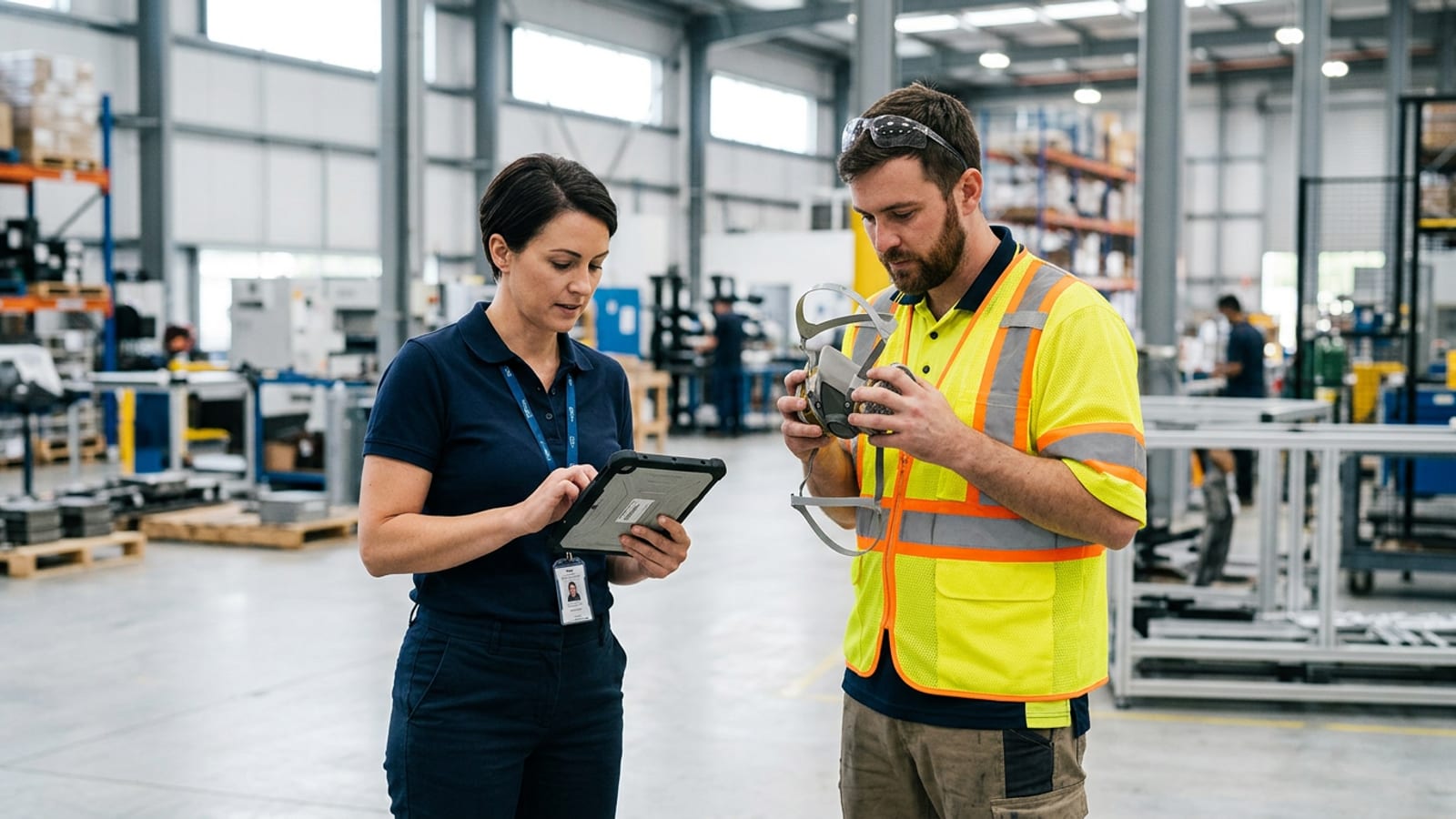
I spent years on plant sites and in safety meetings before I joined VestMed. In that time I heard "mask fit test" far more often than "respirator fit test." Same room, same hood, same spray bottle. Different words.
Last month a safety director asked me, halfway through a conversation about respirator programs, "Wait, do you mean a mask fit test?" Yes. That is exactly what I meant.
So this article uses both terms. If you call it a mask fit test, you are not wrong. OSHA calls it a respirator fit test, and the rule that governs it has a step before the test that most crews skip. That step is the point of this article.
Mask fit test and respirator fit test are the same thing
OSHA's respiratory protection standard, 29 CFR 1910.134, uses the word respirator for every tight-fitting mask a worker wears for protection: N95 filtering facepieces, half-face elastomerics, full-face respirators. In the field, people call all of these masks.
A fit test checks that a specific make, model, and size of respirator seals to a specific person's face. It is required for every tight-fitting respirator before first use, and at least once a year after that. The test is either qualitative (a hood and a test agent the worker can taste or smell) or quantitative (an instrument measures leakage).
So when a site supervisor says "mask fit test," the safety manager says "respirator fit test," and the OSHA inspector says "fit testing under 1910.134(f)," all three are talking about the same requirement.
The step that comes before the fit test
Here is the part that trips up programs. Under 1910.134(e), OSHA requires a medical evaluation before initial fit testing or required respirator use.
Read that order again. Medical evaluation first. Fit test second. Respirator use third.
The medical evaluation exists because wearing a respirator adds breathing resistance and heat. Someone with certain heart, lung, or other conditions may not be able to wear one safely, and the fit test does not check for any of that. The evaluation does.
What the evaluation looks like in practice:
- The employee completes OSHA's medical questionnaire (Appendix C of the standard), or a medical exam that covers the same ground.
- A physician or other licensed health care professional, which OSHA shortens to PLHCP, is responsible for the evaluation. The employer never sees the medical answers, only the result.
- The employer receives a written recommendation: cleared to wear the respirator, cleared with limits, or needs a follow-up exam.
- Then the fit test happens.
Only after both steps can the worker put on a respirator for the job.
Why so many programs have fit test records and no clearances
In my experience, nobody skips the medical evaluation on purpose. The fit test is easy to schedule. A vendor shows up, the crew lines up, everyone gets tested in an afternoon. The medical evaluation needs a clinician, so it waits for a clinic appointment, and the appointment waits for a slow week that never comes.
The result is a filing cabinet of fit test cards with no medical clearance behind them. An auditor who pulls both sets of dates will notice.
A few questions worth asking about your own program this week:
- Does every worker with a fit test on file also have a medical clearance on file, dated before the fit test?
- Are new hires getting the evaluation before their first fit test, or after?
- When a worker switches to a different respirator type, does anyone check if the clearance still covers it?
- Who owns the records, and can they find them in five minutes?
Who needs a mask fit test and a medical evaluation
Anyone required to wear a tight-fitting respirator at work. That covers more jobs than people expect:
| Industry | Common reason |
|---|---|
| Construction | Silica dust, welding fume, lead, asbestos abatement |
| Oil and gas | Hydrogen sulfide, benzene, confined space work |
| Healthcare and senior living | N95 use for airborne infection control |
| Manufacturing | Paint, solvents, metal fume, grain dust |
| Pharmaceutical and labs | Powders, solvents, biological agents |
| Fire, EMS, and public works | Smoke, chemical exposure, wastewater |
Loose-fitting powered air-purifying respirators do not require a fit test, since nothing has to seal to the face. They still require the medical evaluation.
One more case I see often: companies that hand out N95s as a voluntary courtesy. If use is voluntary and the mask is a filtering facepiece, OSHA requires Appendix D information for the worker but not a fit test or medical evaluation. If the company requires the mask, the full program applies.
How to get the order right without slowing the crew down
The clinic bottleneck is the real problem. Here is how programs I have seen fix it:
- Move the medical evaluation online. The OSHA-compliant questionnaire can be completed on any device with an internet connection, including laptops, tablets, and phones, in less than 15 minutes. Most workers are cleared without a visit.
- Run the evaluation during onboarding, before the fit test vendor is booked. Then the fit test day is only a fit test day.
- Keep both records in one place, tied to the worker, with dates. Fit tests expire annually. Clearances get reviewed when health or job conditions change.
- Use the words your crew uses on the schedule and the sign-up sheet. "Mask fit test" on the whiteboard is fine. The records should carry the OSHA terms so an auditor can follow them.
Where VestMed fits
VestMed handles the first step. Employees complete the OSHA-compliant MEQ online in less than 15 minutes. Most workers receive near-instant clearance through our proprietary, physician-developed review algorithm. All others are reviewed and evaluated by a physician or other licensed health care professional (PLHCP). The safety team sees every clearance in one dashboard, ready before the fit test. Pricing is per use, with no monthly fees, and fit test record storage is available as an add-on so both dates live together.
If you are scheduling a mask fit test for your crew and are not sure the medical clearances are in place, that is the question to answer first.
Quick answers
What is a mask fit test?
Does OSHA require a medical evaluation before a mask fit test?
Is a mask fit test the same as a medical clearance?
How often is a mask fit test required?
Can the medical evaluation be done online?
Related reading
- Fit Testing
What Is Respirator Fit Testing? A Plain-English OSHA Guide
Plain-English guide to OSHA respirator fit testing: who needs it, how often, qualitative vs quantitative, and PLHCP medical clearance prerequisites.
- OSHA Compliance
What is Respirator Clearance?
What respirator clearance is, who needs it, how the MEQ works, and the advantages of online clearance with VestMed. OSHA-compliant and PLHCP-reviewed.
- Fit Testing
Mobile Fit Testing: Clear Workers Before the Crew Arrives
Mobile fit testing works only when workers are cleared first. What OSHA requires, how to prep for test day, and how online clearance keeps it on track.