Fit Testing
Mobile Fit Testing: Clear Workers Before the Crew Arrives
 By Jason HardyChief Technology Officer
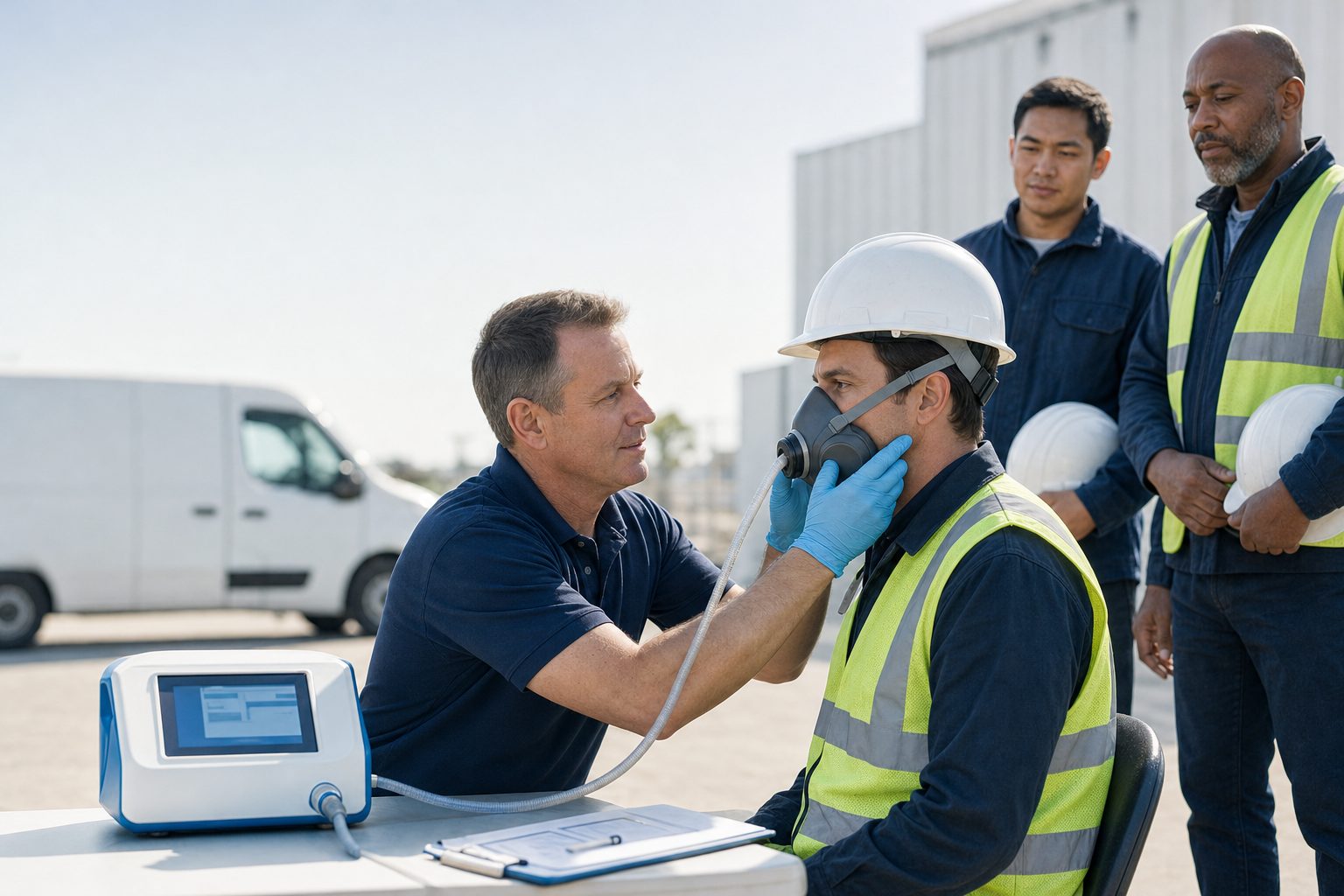
Mobile fit testing brings the fit test to your site instead of sending workers to a clinic. It saves travel time and keeps crews close to the job. But a mobile fit test only works if every worker due for an initial fit test is medically cleared first, because OSHA requires a medical evaluation before initial fit testing or required respirator use.
This guide covers what OSHA requires, how to prepare for test day, and how online clearance keeps the schedule intact.
What is mobile fit testing?
A mobile fit-test provider comes to your facility, job site, or office and runs fit tests on location. Under 1910.134(f)(1), employees must pass an appropriate qualitative fit test (QLFT) or quantitative fit test (QNFT), using an OSHA-accepted protocol from Appendix A.
| Fit test type | How it works | When it can be used |
|---|---|---|
| Qualitative (QLFT) | Pass or fail: a worker who detects the test agent fails | Only for negative pressure air-purifying respirators that must achieve a fit factor of 100 or less (1910.134(f)(6)) |
| Quantitative (QNFT) | An instrument measures leakage and produces a numeric fit factor | Any tight-fitting respirator |
For a deeper look at each method, see qualitative respirator fit testing and quantitative respirator fit testing.
Medical clearance before a fit test: what OSHA requires
Under 1910.134(e)(1), the employer must provide a medical evaluation "before the employee is fit tested or required to use the respirator in the workplace." A worker without clearance can't take an initial fit test.
On a mobile test day, that turns into a familiar problem. The crew arrives, the equipment is set up, and some workers on the list never completed clearance. Those workers can't be fit tested yet. You pay for a return visit, the crew waits, and the schedule slips.
How often is fit testing required?
Fit testing is not a one-time event. Under 1910.134(f)(2), workers must be fit tested before initial use, whenever a different respirator facepiece (size, style, model, or make) is used, and at least annually after that.
Medical evaluation follows its own rules. OSHA requires it before initial fit testing or required respirator use, and requires additional evaluations in specific situations under 1910.134(e)(7). Those include a worker reporting medical signs or symptoms related to the ability to use a respirator, and observations made during fit testing that show a need for reevaluation. A good fit tester flags those on test day.
How to prepare for a mobile fit test day
- Confirm who needs testing. List every worker who must wear a tight-fitting respirator, and the respirator model and size each one uses.
- Clear every new worker first. Make sure each worker on the list has a completed medical evaluation and a written recommendation from the PLHCP before test day.
- Check for changes. Flag anyone switching to a different respirator facepiece. They need a new fit test.
- Brief workers on facial hair. Tight-fitting respirators can't be worn when facial hair comes between the sealing surface and the face (1910.134(g)(1)(i)(A)). Workers should arrive clean-shaven where the seal sits.
- Have the records ready. Keep clearance records and the previous fit test results where the tester and your safety lead can reach them.
How online medical clearance keeps test day on schedule
The simplest fix for uncleared workers is to clear them online before the crew rolls. With VestMed:
- Workers complete an OSHA-compliant MEQ online, in less than 15 minutes, on any device with an internet connection, including laptops, tablets, and phones.
- Most workers receive near-instant clearance through VestMed's proprietary, physician-developed review algorithm. All others are reviewed and evaluated by a physician or other licensed health care professional (PLHCP).
- Records stay on file and audit-ready, with multi-site administration for employers that test across locations.
Employers can send the MEQ link a week or two before the visit and check the clearance list the day before.
For mobile fit-test providers
Run a mobile fit-test service? See how providers offer clearance to their clients through the Reseller Partner Program.
Frequently asked questions
Does OSHA require annual respirator fit testing?
Do workers need medical clearance before a fit test?
What is the difference between qualitative and quantitative fit testing?
Can workers have a beard during a fit test?
What does an N95 fit test do?
How do you pass a fit test?
How can employers clear workers before a mobile fit test?
Related reading
- Fit Testing
Mask Fit Test vs. Respirator Fit Test: What OSHA Requires First
Mask fit test and respirator fit test mean the same thing. OSHA requires a medical evaluation before either one. Here is the order, who needs it, and how to keep records straight.
- Fit Testing
What Is Respirator Fit Testing? A Plain-English OSHA Guide
Plain-English guide to OSHA respirator fit testing: who needs it, how often, qualitative vs quantitative, and PLHCP medical clearance prerequisites.
- OSHA Compliance
What is Respirator Clearance?
What respirator clearance is, who needs it, how the MEQ works, and the advantages of online clearance with VestMed. OSHA-compliant and PLHCP-reviewed.
- Fit Testing
Qualitative Respirator Fit Testing (QLFT): A Complete Guide
Complete guide to OSHA-approved Qualitative Fit Testing (QLFT). When QLFT applies, the four agents, equipment, recordkeeping, and PLHCP clearance prerequisites.