
Fit Testing
Where to Get an N95 Fit Test for Care Staff: Onsite, Mobile, or Clinic (and What Has to Happen First)
 Michael MartinezSr. Director of Sales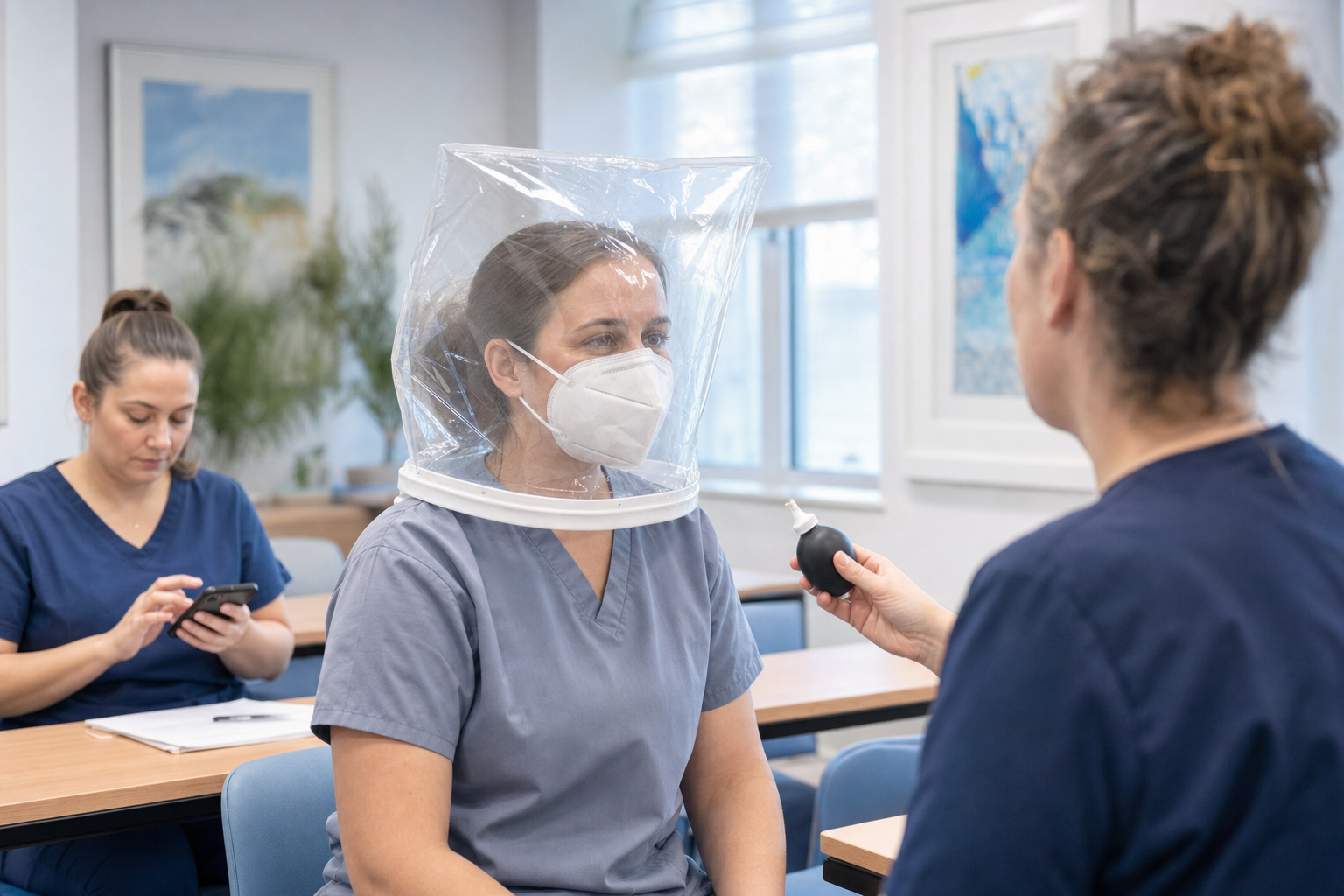
A director of nursing types "N95 fit test near me" for one of two reasons. A resident went on airborne precautions this morning and the building needs staff cleared to enter the room, or a new hire class starts Monday and nobody has a fit test. Both are solvable this week. Both go faster when the order is right.
The medical clearance comes first
Under OSHA 29 CFR 1910.134, the medical evaluation comes before the fit test. The employer provides a medical evaluation "before the employee is fit tested or required to use the respirator in the workplace" (1910.134(e)(1)). The employee completes the questionnaire in Appendix C, and a physician or other licensed health care professional (PLHCP) reviews it and issues a written recommendation.
This is the step that used to take days, because it meant an appointment at an occupational health clinic. Done online, it takes minutes. A caregiver completes the questionnaire on a phone, a PLHCP reviews it, and the clearance comes back. With VestMed, the average is about 20 minutes, and the service runs 24/7. Once the clearance is on file, the fit test can be scheduled the same day, with whichever option fits the building.
The three fit testing options
1. Onsite, with your own trained tester
OSHA does not require a license or certification to conduct a fit test. The person running it has to be able to perform the test correctly using one of the accepted protocols in 1910.134 Appendix A, recognize an invalid test, and keep the record. Many senior living organizations train an infection preventionist, staff development nurse, or safety lead to do this.
N95s can be qualitatively fit tested. Under 1910.134(f)(6), qualitative fit testing (QLFT) may be used for half-facepiece respirators where the required fit factor is 100 or less, which covers N95 filtering facepieces. A qualitative kit uses a hood and a test agent such as saccharin or Bitrex, and the test takes roughly 15 to 20 minutes per person. A quantitative machine gives a numeric fit factor and is faster per person but costs more.
Best for: buildings with steady headcount and a stable staff development function. Once the tester is trained and the kit is on hand, a new hire can be fit tested the day the clearance comes back.
2. Mobile fit testing provider
A mobile provider brings the equipment and the tester to the building and runs the whole staff in a day. This is how many multi-site operators handle annual renewals: one visit per building, everyone cycled.
Best for: annual renewal days, outbreak surges, and organizations that would rather not maintain their own kit and tester. The catch is scheduling. A mobile provider is booked for the day, so the medical clearances have to be done before the visit, or the tester spends the day waiting on paperwork.
3. Clinic or partner network
Occupational health clinics and urgent care centers with occupational services perform fit testing by appointment. This works for a handful of people, and for agency or PRN staff who join between renewal days.
Best for: low volume and one-off needs. The trade-off is staff time. A clinic visit is hours out of a shift, and appointment availability sets the pace.
Comparison for senior living operators
| Option | Speed for a new hire | Cost per person | Fits high turnover | Records | Notes |
|---|---|---|---|---|---|
| Onsite, own tester | Same day | Low after setup | Yes | Your responsibility | Requires a trained tester and a kit for the N95 model in stock |
| Mobile provider | Next scheduled visit | Moderate | Partially | Provider supplies, you store | Best for renewal days; clear staff online before the visit |
| Clinic | Appointment dependent | Moderate to high, plus staff time | No | Clinic supplies, you store | Best for small numbers |
In every option, the clearance step is the same and can be done online before the test.
New hires, agency staff, and PRN
Care settings run on people who started recently. Mean annual turnover for nursing staff in U.S. nursing homes was about 128% in a national payroll study (Health Affairs, March 2021). A once-a-year fit test day cannot cover that. A workable onboarding sequence looks like this:
- Orientation, day one. New hire completes the online medical evaluation questionnaire. Clearance returns the same day.
- Same week. Fit test on the N95 model the building stocks. Record make, model, style, size, date, and result.
- Before first shift on an airborne-precautions unit. Respirator training completed and recorded (1910.134(k)).
- Agency and PRN staff. Ask for a current fit test record on the same respirator model. If they have one within the past year, get the clearance on file (dated before that fit test) and accept the record. If not, run steps 1 and 2 on arrival.
- Renewal. Fit test and training repeat at least annually (1910.134(f)(2)). Put the date in a system that tracks it per building.
What to keep from every fit test
Fit test records are retained until the next fit test is administered (1910.134(m)(2)). Each record should show the employee's name, the type of test, the specific make, model, style, and size of respirator, the date, and the result. Medical evaluation records are kept much longer: the length of employment plus 30 years (1910.134(m)(1), 1910.1020). Keeping both beside each other, per person, per building, is what makes a survey request a two-minute task.
How VestMed fits
Pricing is per use, with no monthly fees, so a building that onboards four people this month pays for four clearances and a building that onboards forty pays for forty. VestMed handles the step that comes first: staff complete the OSHA medical evaluation questionnaire online, a PLHCP reviews it, and the written clearance returns in about 20 minutes on average, 24/7. The fit test then happens wherever the building chooses, and the record for the N95 or elastomeric respirator is stored beside the clearance with 30-year digital retention. Multi-location administration gives a regional director one view across every building.
Sources
- 29 CFR 1910.134, Respiratory Protection, including Appendix A fit testing procedures (eCFR, current)
- 29 CFR 1910.1020, Access to employee exposure and medical records
- Health Affairs, March 2021, nursing home staff turnover (UCLA CHPR summary)
- CDC, TB Infection Control in Health Care Settings (reviewed Dec 15, 2023)
This page provides general information and is not a substitute for professional or legal advice.
Clear your staff online before the fit test
VestMed handles the online medical evaluation and PLHCP review so clearance is on file before the fit test, whichever testing option you choose.
See the senior living workflow or read about fit test record storage.
Frequently asked questions
Can we do our own N95 fit testing?
Is a qualitative fit test enough for an N95?
Can staff be fit tested before they are medically cleared?
How long does a fit test take?
Do we need a fit test for every N95 model in the building?
Does the fit test transfer between facilities?
Related reading
- Fit Testing
N95 Fit Testing Requirements for Nursing Homes and Senior Living Staff
What OSHA requires before a caregiver wears an N95: medical clearance, then fit testing before first use and annually. A plain guide for nursing homes.
- OSHA Compliance
CMS Infection Control Survey Readiness: A Respiratory Protection Checklist for Skilled Nursing (F880)
F880 surveyors check how staff are protected on airborne precautions. Use this respiratory protection checklist to get clearances, fit tests, and records ready.
- Fit Testing
Qualitative Respirator Fit Testing (QLFT): A Complete Guide
Complete guide to OSHA-approved Qualitative Fit Testing (QLFT). When QLFT applies, the four agents, equipment, recordkeeping, and PLHCP clearance prerequisites.
- Fit Testing
Qualitative vs Quantitative Fit Testing
QLFT vs QNFT compared: how each fit test method works, when OSHA requires each, and which respirators they apply to.
- Fit Testing
What Is Respirator Fit Testing? A Plain-English OSHA Guide
Plain-English guide to OSHA respirator fit testing: who needs it, how often, qualitative vs quantitative, and PLHCP medical clearance prerequisites.
- Industry Guides
Respirator Clearance for Senior Living: A Compliance Guide for Elder Care Operators
Senior living caregivers who wear N95s need documented respirator clearance before fit testing. Learn what OSHA requires and how to prepare records for surveys.