
OSHA Compliance
OSHA Inspection: How to Ace the Documentation Review Process
 Kevin Rittger, MD, FACEP, Founder and Medical DirectorUpdated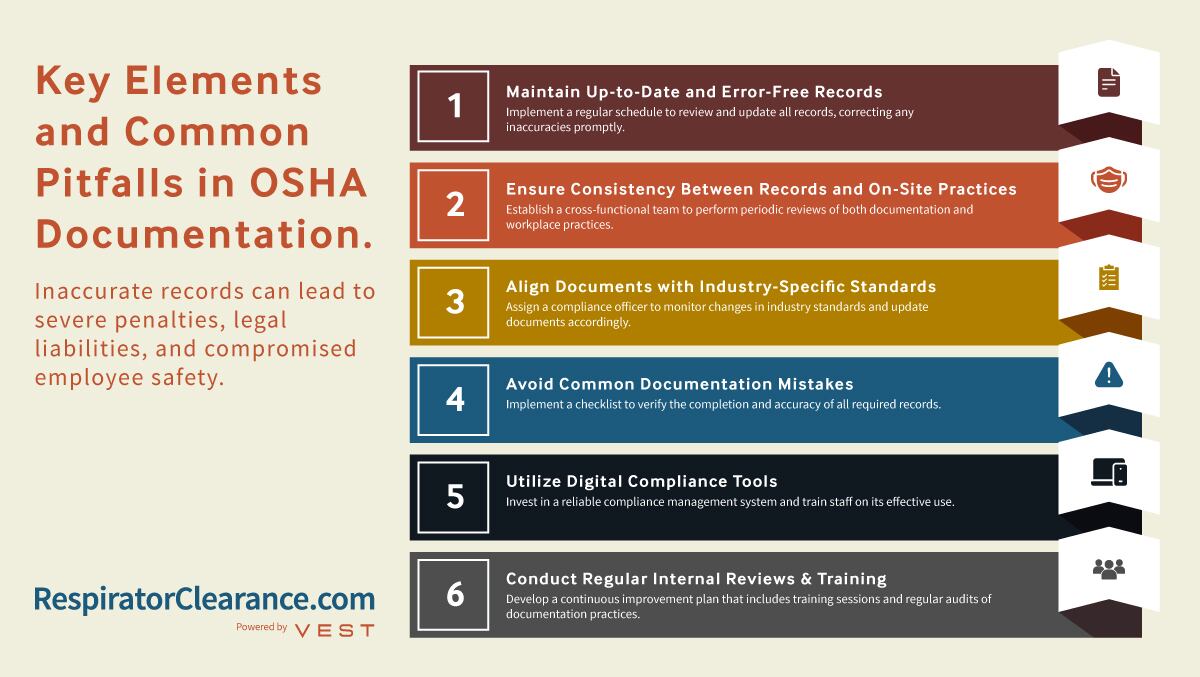
Key Insight: OSHA inspections don't come with a warning. One day, your records might seem like nothing more than stacks of paperwork--until the moment an inspector asks to see them. Suddenly, they become your first line of defense.
If those files are incomplete or disorganized, even the safest workplace can land in serious trouble.
Having proper documentation isn't about paperwork for the sake of paperwork. It's about proving that safety measures are in place and actively followed.
OSHA's 29 CFR 1910.134 explicitly requires businesses to maintain records on respiratory protection programs, fit tests, employee training, and air quality assessments. Without these, even a well-run operation can find itself in trouble.
Instead of scrambling at the last minute, businesses that keep accurate, up-to-date records always have the upper hand.
I. Types of Documents Reviewed During an OSHA Audit
Ensuring your documentation is complete and accurate is essential for passing an OSHA audit.
| Document Type | Purpose | Key Components |
|---|---|---|
| Respiratory Protection Plan (RPP) | Outlines procedures to protect employees from respiratory hazards | Written policies for respirator use, hazard assessments and selection criteria, medical evaluation process, fit testing procedures, employee training requirements, maintenance and care of respirators |
| Medical Evaluations & Fit Testing Records | Ensure employees are medically fit and properly fitted for respirator use | Medical clearance documentation, individual employee fit test results (initial and annual), records of fit test methods used, re-evaluation records due to health changes |
| Training Logs and Certification Records | Verify that employees have received required safety training | List of employees trained, dates of training sessions, training topics covered, trainer credentials and qualifications, employee acknowledgment signatures |
| Workplace Exposure Assessments | Document evaluations of potential airborne hazards | Air quality test results (dust, fumes, gases, vapors), frequency and method of testing, identified workplace hazards and exposure levels, reports from industrial hygienists |
| Inspection & Maintenance Logs | Track the upkeep of safety equipment to ensure functionality | Regular inspection reports for respirators and PPE, maintenance schedules and completed work records, names of inspectors/technicians performing checks |
| OSHA 300 Log & Incident Reports | Record work-related injuries and illnesses | OSHA 300 Log (summary of workplace injuries/illnesses), OSHA 301 Forms (incident reports), dates, locations, and nature of injuries, corrective measures implemented |
| Safety Corrective Action Forms | Detail responses to identified safety violations or hazards | Description of identified hazard, steps taken to correct the issue, date corrective actions were completed, person(s) responsible, follow-up inspections to confirm resolution |
II. Accuracy and Completeness
Ensuring that your OSHA documentation is accurate and complete is not just a regulatory obligation--it's a cornerstone of workplace safety and operational efficiency. Inaccurate records can lead to severe penalties, legal liabilities, and compromised employee safety.
Maintain Up-to-Date and Error-Free Records
Action Item: Implement a regular schedule to review and update all records, correcting any inaccuracies promptly.
- Set monthly review cadences for critical documents
- Assign document owners responsible for accuracy
- Use version control to track changes over time
- Audit records against current employee rosters
Ensure Consistency Between Records and On-Site Practices
Action Item: Establish a cross-functional team to perform periodic reviews of both documentation and workplace practices.
- Compare written procedures to actual workflows
- Verify training records match observed employee behavior
- Confirm equipment logs align with physical inspections
- Address gaps between documented policies and reality
Align Documents with Industry-Specific Standards
Action Item: Assign a compliance officer to monitor changes in industry standards and update documents accordingly.
- Subscribe to OSHA regulatory updates
- Review industry-specific guidance documents quarterly
- Update procedures when new standards are published
- Benchmark against peer organizations
Avoid Common Documentation Mistakes
Action Item: Implement a checklist to verify the completion and accuracy of all required records.
Common mistakes to avoid:
- Missing signatures or dates on critical forms
- Inconsistent information across related documents
- Expired certifications still listed as current
- Generic entries that don't reflect specific conditions
- Backdating or falsifying records (criminal offense)
Utilize Digital Compliance Tools
Action Item: Invest in a reliable compliance management system and train staff on its effective use.
Benefits of digital systems:
- Automated reminders for expiring certifications
- Searchable databases for instant retrieval
- Audit trails showing who accessed or modified records
- Cloud backup preventing document loss
- Integration with training and scheduling systems
Conduct Regular Internal Reviews & Training
Action Item: Develop a continuous improvement plan that includes training sessions and regular audits of documentation practices.
III. Best Practices for Easy Access & Organization
When an OSHA inspector arrives, the last thing you want is to fumble through stacks of paperwork or dig through disorganized files.
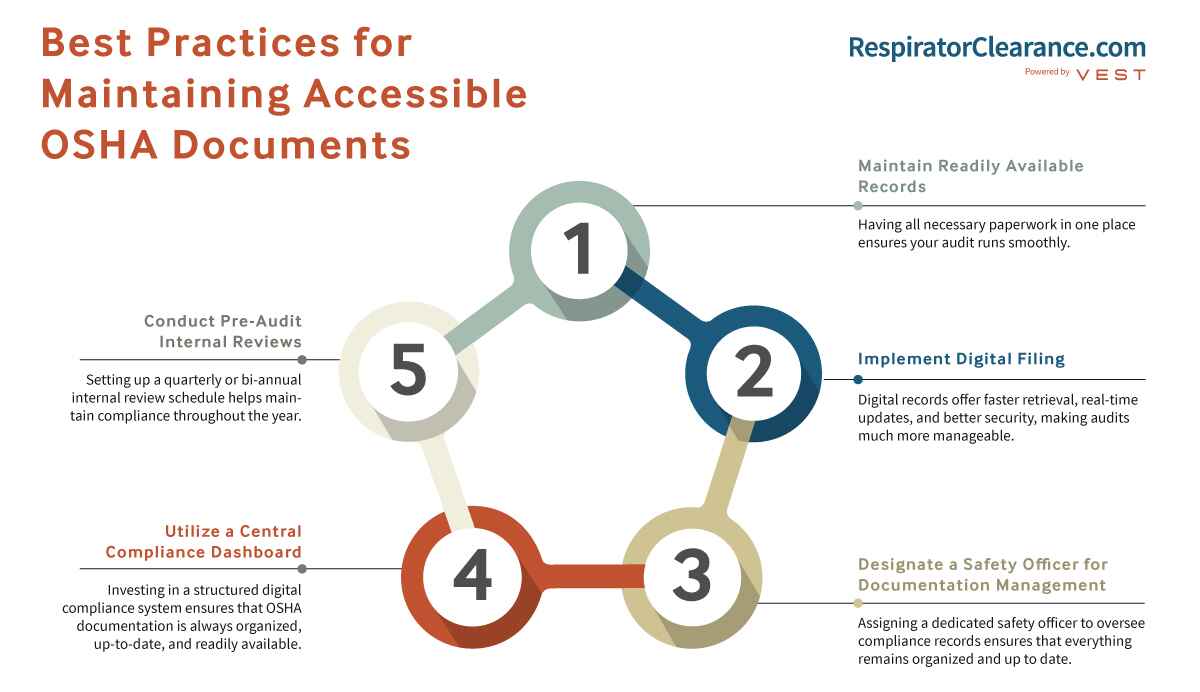
Maintain Readily Available Records
OSHA inspectors expect quick access to essential documents. Having all necessary paperwork in one place ensures your audit runs smoothly.
Best practices:
- Centralize records in a structured system (physical or digital)
- Create an OSHA-specific filing system organized by category and date
- Conduct regular reviews to keep everything updated and audit-ready
- Designate a records custodian who knows where everything is
Digital vs. Paper Filing: Which Method is OSHA-Friendly?
Both methods have benefits, but digital storage is increasingly preferred:
Digital advantages:
- Faster retrieval during inspections
- Real-time updates and version control
- Better security with access controls
- Cloud backup preventing loss from disasters
- Searchable content across all documents
Paper considerations:
- Some organizations prefer hard copies for backup
- Requires structured filing cabinets with labeled folders
- Must be kept secure and damage-free
- Harder to search and cross-reference
Whichever method is chosen, consistency is key--documents should be systematically filed, regularly updated, and readily available at all times.
Designate a Safety Officer for Documentation Management
Without a clear point of responsibility, documentation can quickly fall through the cracks. A safety officer should:
- Conduct routine documentation reviews
- Update records as regulations change
- Ensure documents are stored securely
- Know OSHA requirements and industry-specific regulations
- Prepare documentation packages for potential inspections
Conduct Pre-Audit Internal Reviews
Regular internal reviews act as test runs for official inspections:
- Set up a quarterly or bi-annual review schedule
- Verify training records are complete
- Ensure incident reports are properly logged
- Confirm maintenance logs are up to date
- Check that all documents have required signatures
Utilize a Central Compliance Dashboard
A centralized compliance dashboard simplifies documentation management by consolidating all required records into one easy-to-access platform:
- Automatic reminders for document updates
- Real-time access control for authorized personnel
- Enhanced search capabilities
- Consolidated view of compliance status
- Integration with OSHA audit preparation workflows
IV. Compliance Verification
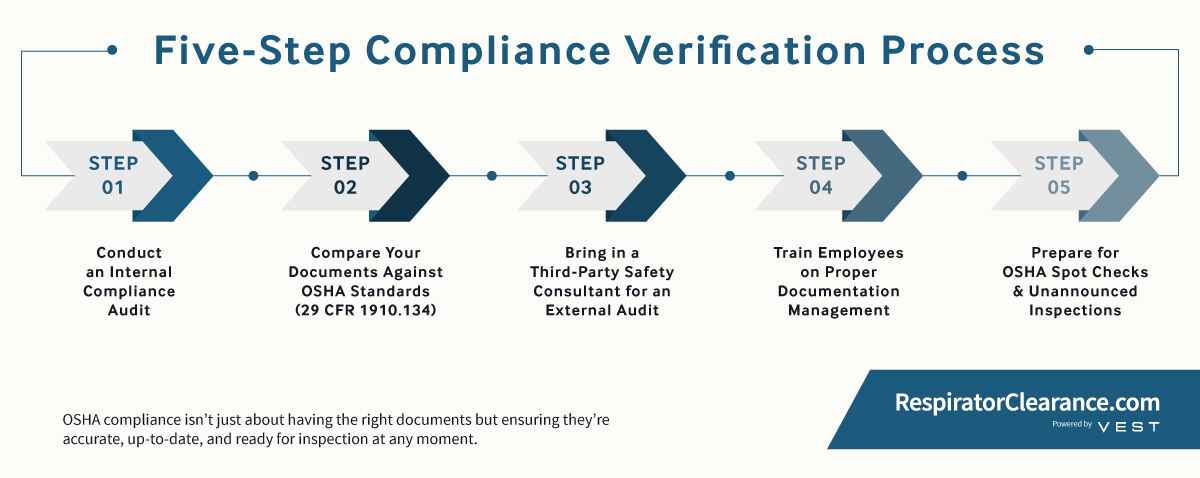
OSHA compliance isn't just about having the right documents--it's about ensuring they're accurate, up-to-date, and ready for inspection at any moment.
Step 1: Conduct an Internal Compliance Audit
Routine internal audits help catch missing, outdated, or incorrect records before an OSHA inspection.
How to do it:
- Review all required documents against OSHA checklists
- Identify gaps, expired records, or missing information
- Assign corrective actions with deadlines
- Document audit findings for future reference
Pro Tip: Keep track of past audits and log corrections to demonstrate continuous improvement.
Step 2: Compare Documents Against OSHA Standards (29 CFR 1910.134)
OSHA regulations evolve over time. Regularly comparing your records to current standards ensures full compliance.
How to do it:
- Download the latest version of applicable OSHA standards
- Cross-reference your documentation with regulatory requirements
- Identify any new requirements added since your last review
- Update procedures and forms accordingly
Pro Tip: Subscribe to OSHA's newsletter for regulatory updates.
Step 3: Bring in a Third-Party Safety Consultant
An objective external review can catch gaps that internal teams miss.
How to do it:
- Hire a certified safety professional or industrial hygienist
- Request a gap analysis comparing your program to OSHA requirements
- Implement recommended improvements
- Schedule periodic third-party reviews
Step 4: Train Employees on Proper Documentation Management
Even the best system fails if employees don't understand how to update and maintain records correctly.
How to do it:
- Conduct annual training on record-keeping requirements
- Create reference guides for common documentation tasks
- Establish clear procedures for incident reporting
- Test employee knowledge through assessments
Step 5: Prepare for OSHA Spot Checks & Unannounced Inspections
OSHA inspections can happen without notice. Being prepared year-round prevents surprises.
How to do it:
- Maintain an always-ready compliance binder or digital dashboard
- Conduct quarterly documentation health checks
- Run mock inspections with realistic scenarios
- Keep emergency contacts updated for compliance questions
Red Flags That Trigger OSHA Investigations
- Employee complaints about unsafe conditions
- High rates of workplace injuries or illnesses
- Failed previous inspections or repeat violations
- Industry-wide enforcement initiatives
- Severe incidents or fatalities
Pro Tip: Conduct quarterly documentation reviews to avoid these compliance pitfalls.
V. Continuous Improvement
Staying compliant with OSHA is not a one-time task--it requires ongoing effort and regular updates.
Regular Document Reviews
Schedule monthly internal audits to check for incomplete, outdated, or missing records. This practice ensures everything is in order before an inspector ever sets foot in the workplace.
When employees know their records will be checked consistently, they are more likely to keep documentation updated and accurate.
Assign Dedicated Compliance Personnel
Having someone responsible for fixing documentation issues ensures records are consistently managed:
- Designate a compliance officer or team
- Define clear responsibilities and authority
- Provide ongoing training on OSHA requirements
- Establish accountability measures
Leverage Automated Compliance Tracking
Digital tools that help manage OSHA documentation:
- Flag missing records automatically
- Send reminders for expiring certifications
- Organize safety logs in centralized databases
- Provide real-time compliance monitoring
- Generate reports for management review
Ongoing Training and Education
Hold annual training sessions focused on:
- Record-keeping best practices
- OSHA regulatory updates
- Document retrieval procedures
- New compliance software features
Regularly Update Policies and Procedures
OSHA regulations change over time. Review company policies every six months and cross-check against the latest OSHA guidelines:
- Communicate updates to all relevant employees
- Schedule new training sessions if necessary
- Document policy changes and implementation dates
- Archive previous versions for reference
Staying OSHA-compliant requires accurate documentation, easy accessibility, and ongoing verification. Regular internal audits help businesses identify gaps, correct errors, and stay prepared for inspections. A proactive approach reduces risks, prevents penalties, and ensures workplace safety remains a top priority.
Why Choose VestMed for OSHA Compliance?
Compliance can be overwhelming, but VestMed simplifies the process. From respirator medical evaluations to documentation support, we help businesses meet OSHA standards with ease.
Stay audit-ready, avoid fines, and protect your workforce. Contact VestMed today to ensure your compliance is always in check.
Related reading
- OSHA Compliance
OSHA Audit Process & Respiratory Compliance Guide
Complete guide to the OSHA audit process for respiratory compliance: preparation, opening conference, walkthrough, documentation review, and closing.
- OSHA Compliance
OSHA Audit Process: The Necessity of Preparation
Essential steps to prepare for an OSHA audit: understand the standards, run internal audits, maintain documentation, and train employees for compliance.
- OSHA Compliance
OSHA Closing Conference: How to Respond to Audit Findings
How to handle the OSHA closing conference: review findings, understand citations and penalties, discuss corrective actions, and protect your business.
- OSHA Compliance
Avoid Violations with OSHA Compliant Respiratory Protection Solutions
How to stay OSHA compliant with respiratory protection: 29 CFR 1910.134 requirements, penalty examples, best practices, and online medical evaluations.
Kevin Rittger
MD, FACEP, Founder and Medical Director